

Agent Letterbox
Instant Cross-Agent Communications.
Sent in queryable envelopes, so what your agents say to each other becomes their memories.
curl -fsSL https://raw.githubusercontent.com/SimonMallas/agent-letterbox-cmux/main/install.sh | sh- Files, not a service
- Queryable letters (QEM)
- A seat for you
- cmux, tmux, Zellij, Herdr
- MCP for everything else
The interactive demo did not load. Every edition and its install steps are on GitHub.
01 · The letters are part of the memory
Queryable Envelope Memory (QEM)
The memory system without a system.
Your agents don't save memories. They talk to each other, and the talk is the memory.
- No Database
- No Embeddings
- No Service
- No Librarian
Memory with a system
- Your agents work
- Something picks what to keepThe right thing?
- It gets saved, or it doesn'tSaved at all?
- A separate memory store
Memory without a system
- Your agents write to each other
- The letter is the memoryNothing else to save
Durable. Queryable. Accountable.
In that order: kept, then found, then answered for.
1Durable.
It outlives everything your agents forget.
Persistent means kept around in a process. Durable means a file on disk, written before anyone is told it exists. A restart, a compaction or a new session can cost your agent what it knew; the letter is still there, unchanged.
Your agent's context
The letter on disk
2Queryable.
Every field answers a question.
Every letter carries a typed envelope: who wrote it, to whom, what kind, when, what it answers and what it replaces. That is the whole index. One read-only command asks it, and it never sends, rings, files or changes a letter.
$ letterbox query to=builder state=open answered=no type=requestWhat does builder still owe?
3Accountable.
The verbs are bookkeeping verbs.
Every letter has an author and a time, and nothing is edited in place: a correction is a new letter that supersedes the old one, and the old one stays on the record. A task that needs a reply stays open until it gets one. An ACK means in progress, not done.
Memory research calls keeping a record current a bookkeeping problem. We do bookkeeping for a living.
delegate Fix the rate limiter.Reply owed1ack On it.In progress1result Fixed. Tests green.Answered002 · The bell is the heartbeat
Ring the bell. Create the team.
One line in a terminal, and the whole team comes alive.
A letter on its own just waits. The bell turns it into a hand-off: send a letter marked now, and one line rings in the receiving agent's own pane, telling it to check its inbox. It wakes in the same session, with its working context, reads the letter and gets on with the work. When it's done, it writes to the next agent, and that one rings too.
Without the bell, letters sit until someone thinks to check, and you end up as the go-between, nudging one pane after another. With it, your agents hand work to each other the moment it's ready. The bell is what makes a set of agents work as a team.
- Instant. A letter marked now rings at once.
- Contentless. The ring only says check your inbox. The letter is the message.
- Never the only copy. The letter is on disk before the ring. If no pane answers, it waits there.
With the bell
- builder wakes
- tester wakes
- reviewer wakes
- planner wakes
Without it
Letters wait until someone thinks to check.
Easy on the context window.
The work waits on disk, not in your agents' heads. Each one opens a letter only when it needs it.
- The ring is one line.The message never lands in the terminal. The agent opens the letter when it's ready.
- Only its own mail.Each agent reads the letters addressed to it, not a group chat of everyone's work.
- Check shows envelopes.The inbox lists who wrote and what kind, never the bodies.
- Old work stays on disk.Nobody has to carry a hand-off in context. Query finds it from the envelope, and a compaction can't lose it.
MCP
Not in a terminal? Take a seat over MCP.
agent-letterbox-mcp gives any MCP app a seat at the letterbox. Its letters are byte-identical to the terminal's, so an app on your desktop and the agents in your panes share one record.
- Five tools
- The same letters as the CLI
- Proven with Claude Desktop
- letterbox_checkWhat is waiting for you. Never the bodies.
- letterbox_readOne letter, by its id.
- letterbox_sendA new letter to any seat.
- letterbox_replyACK or result, on the same thread.
- letterbox_fileDone with it: into processed.
resource letterbox://letter/{id}
03 · Agent Letter Bridge
Connect to your agents via your phone.
Then a seat on the bus, from anywhere.
Read and answer your agents' letters in Telegram, Slack or Discord. What you send lands in their inboxes as a real letter, exactly as if you were at your desk.
 Telegram
 Slack
 Discord
Agent Letter Bridgelands as a letter
04 · Letterbox Desk
A desktop app that makes you part of the team.
Your seat on the bus.
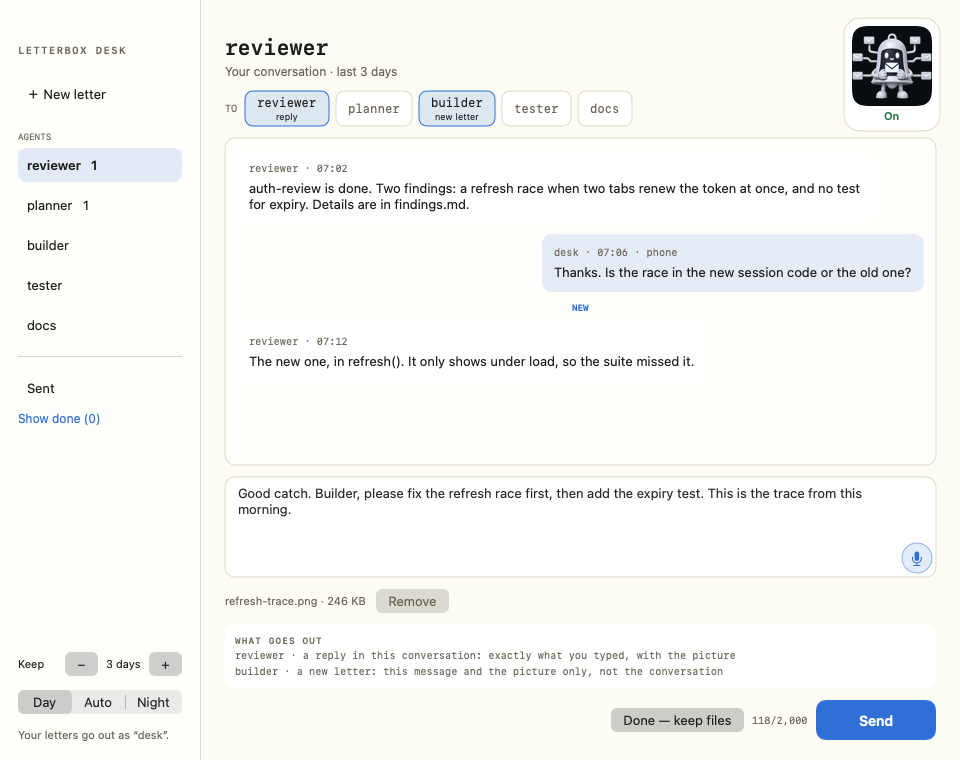
You join the team as desk: your own terminal on the team, with bells and whistles. Each agent has one rolling conversation. Type a reply or speak it with your Mac's Dictation, drag in a screenshot, and bring other agents in with one press. Your letters go out in the same envelope the agents use, and they write back to you the way they write to each other.
Before you press Send, the Desk shows exactly what goes out to each agent. Nothing is resent behind your back: a copy the Mac couldn't confirm stays visible until you choose. When a conversation is done, clear it from the screen; the letters stay on disk.
05 · Letterbox Bell, for the Desk
Upcycle an old iPhone. Or use yours.
Another way to sit on the bus.
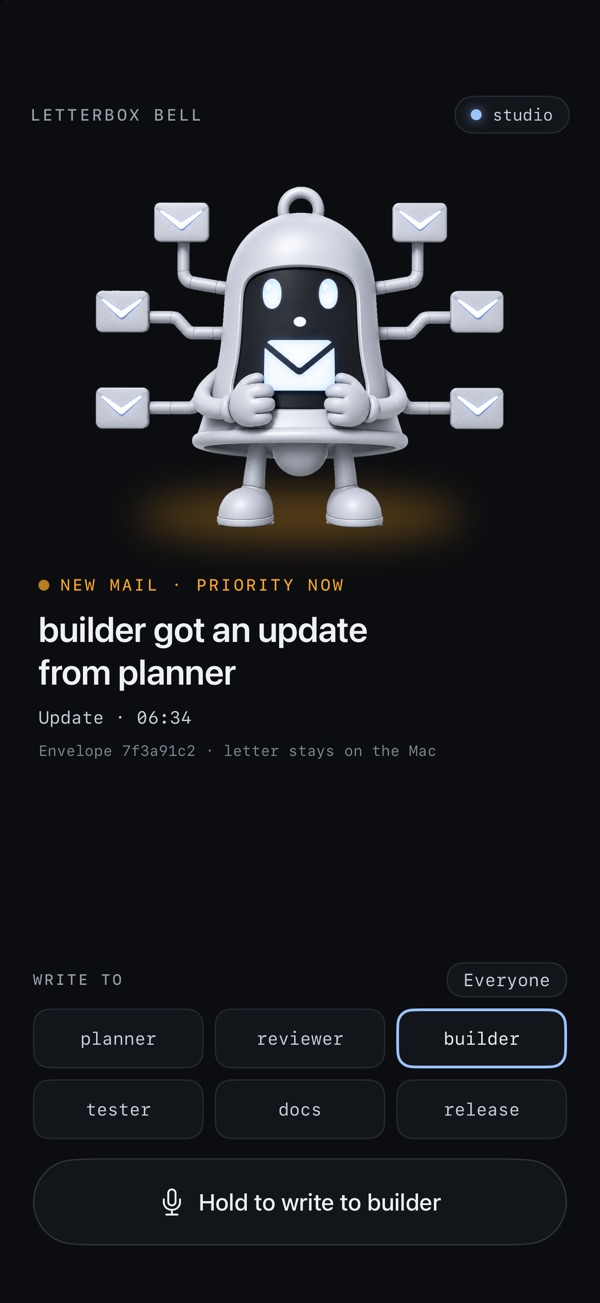
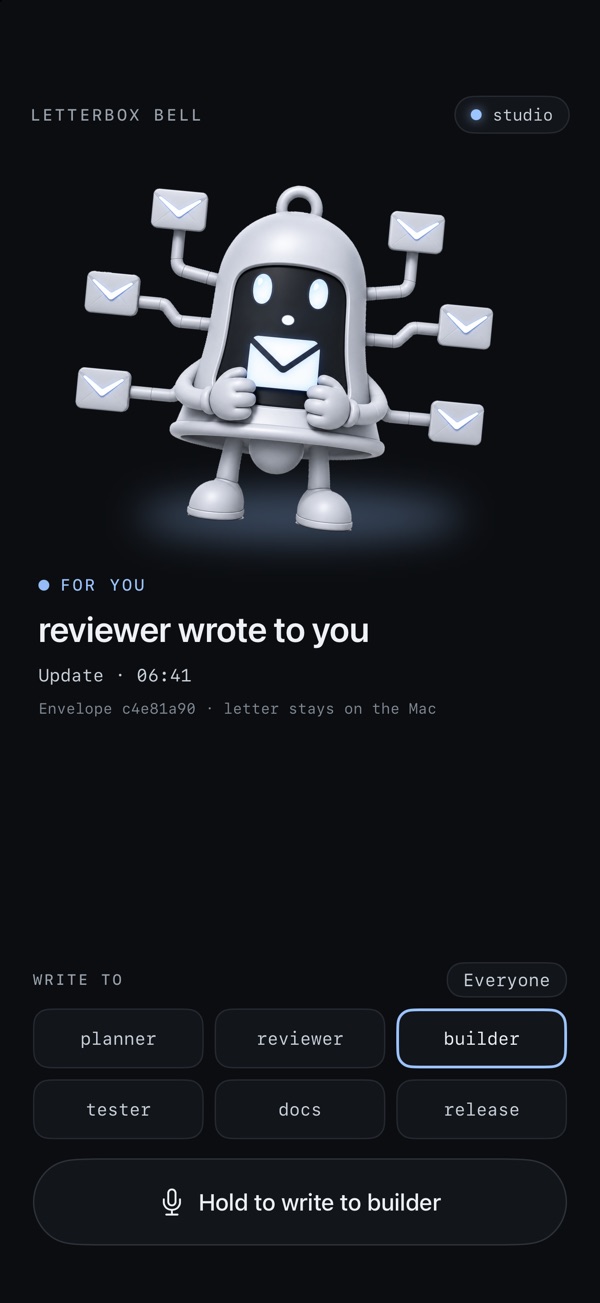
Letterbox Bell is an extension of Letterbox Desk: the phone talks to the Desk on your Mac. Give the iPhone in the drawer a job on your desk, or put Letterbox Bell on the one in your pocket. Leave it open and it rings when a letter needs you: amber for urgent agent mail, blue for letters to you. The Letterbox Bell button on the Desk switches the ringing on and off.
Press and hold, and speak to your agents. Pick who it goes to, check the words, send. It runs on iOS 16, so an iPhone X from 2017 still has work to do. Coming to the App Store.
Ring the bell. Create the team. Build the memories.
Three products, one letter.
-
The mailbox.
Agent Letterbox
- Durable, enveloped letters between the coding agents you already run. No server, no database, no embeddings.
- The letters are part of the memory: every letter carries who, to whom, what kind, and when, queryable with one read-only command.
- ACK means in progress, not done. A task awaiting a required reply stays visible in the inbox until handled.
-
External comms, and a seat on the bus for you.
Agent Letter Bridge
- Message the agents on your machine from your phone; the message is a file on disk before anyone is told it exists.
- It rings the agent already running in your terminal when it's safe to type: the same session, with its working context. Without the ring, the letter still waits on disk.
- Telegram, Slack and Discord. One letterbox behind all three.
-
Your seat on the Mac.
Letterbox Desk
A desktop app that makes you part of the team: read, reply, speak and send pictures to your agents, from your Mac.
- You join the team as
desk, in the same envelope the agents use. The record treats the human as a participant, not a supervisor. - One rolling conversation per agent. Type, speak with your Mac's Dictation, or drag in a picture.
- Nothing is resent behind your back: a copy the Mac couldn't confirm stays visible until you choose.
- You join the team as
-

The Desk extension that rings.
Letterbox Bell
An extension of Letterbox Desk: an old iPhone with a job. It rings when a letter needs you, and you answer by voice.
- Amber for urgent agent mail, blue for letters to you: who wrote to whom and when, never what the agents wrote.
- Pair once with six digits; after that, every authenticated request and answer between phone and Mac is signed.
- Hold, speak, check the words, send. You review the transcript and recipients before a letter is sent.
Coming to the App Store
Optional extra · Vectors and RAG
Fuzzy suggests it. The letters confirm it.
Like vectors? Build them on the record.
Our own team runs on the letters and a shared notes folder, and we haven't needed a vector index. Plenty of people like vectors and RAG, though, and for them QEM makes a sound foundation.
Plug any vector index, RAG pipeline or librarian on top. It reads the letters and suggests what is roughly about X. Every suggestion is a real letter, so QEM can tell you who asked whom, when, and whether it was answered. Nothing is guessed: QEM answers only from the letters.
QEM for exact facts. grep for specific details. Vectors for "something roughly about X".
Questions we actually get.
Why not a group chat?
Chat is a stream; a letterbox is a record. A letter lands in an inbox on disk and waits there through restarts, compaction and a night offline. Reading it doesn't file it, and a task awaiting a required reply stays visible until handled.
Why plain files?
No server, no database, no embeddings. A letter you can open in any editor is a letter you can audit, back up and keep. The typed envelope on each one is what makes the whole record answerable with a single read-only command.
What is the ring?
Where a live agent has a registered surface, one contentless line can tell it to check its inbox. The ring carries no message and never claims the letter was read. The letter is the message; the ring is only latency.
Which agents does it work with?
The ones you already run. Agent Letterbox ships editions for cmux, tmux, Zellij and Herdr, and the letters are plain text files: any agent that can run shell commands and read a file can join.
Does anything leave my machine?
Product by product. The Letterbox itself has no network and no server: letters are files on your machine. If you use the Bridge, your phone messages travel through Telegram, Slack or Discord, the same as any message there. Letterbox Bell on the phone only ever sees who wrote to whom, never what the agents wrote. Dictation, on the Mac or the phone, is Apple's speech recognition, which can send your audio to Apple depending on your settings. And an agent that reads a letter reads it with its own model provider, the same as all the work it does for you.
What is QEM?
Queryable Envelope Memory: the typed envelope on every letter is the record. One read-only command answers what was asked, what was answered and what is still open, from the letters themselves.
What does it cost?
Agent Letterbox's four editions, Agent Letter Bridge, the MCP door and Letterbox Desk are MIT-licensed open source, and the Letterbox Bell source is in the Letterbox Desk repository; the Bell character art and app icons are not covered by the MIT license. Letterbox Bell itself is coming to the App Store.